Why verification is the step people skip
By the time you have a quote you like and a sample you approved, you want to place the order. Verification feels like friction at the worst possible moment. So importers skip it — and that is precisely when the expensive surprises are bought. The factory that quoted is not always the factory that builds. The sample is not always the order. Verification is how you close that gap before, not after, the container is on the water.
It breaks into three layers: checking the documents, checking the place, and checking the product. Do all three.
Document checks: license and certifications
Start with the business license. Every legitimate Chinese company has one, with a unified social credit code, a registered capital figure, an establishment date and a registered business scope. The scope tells you whether you are dealing with a manufacturer or a trading company. The code can be checked against China's public company registry. A supplier that hesitates to send a license has already answered an important question.
Then the certifications. If your product needs CE, RoHS, REACH, FCC or a specific safety standard for the EU market, ask for the certificates — and read them. A certificate names a product and a testing body. A common trick is showing a real certificate for a different product, or one issued to a different company. Confirm the certificate covers your item and is current.
The factory audit: what a real one covers
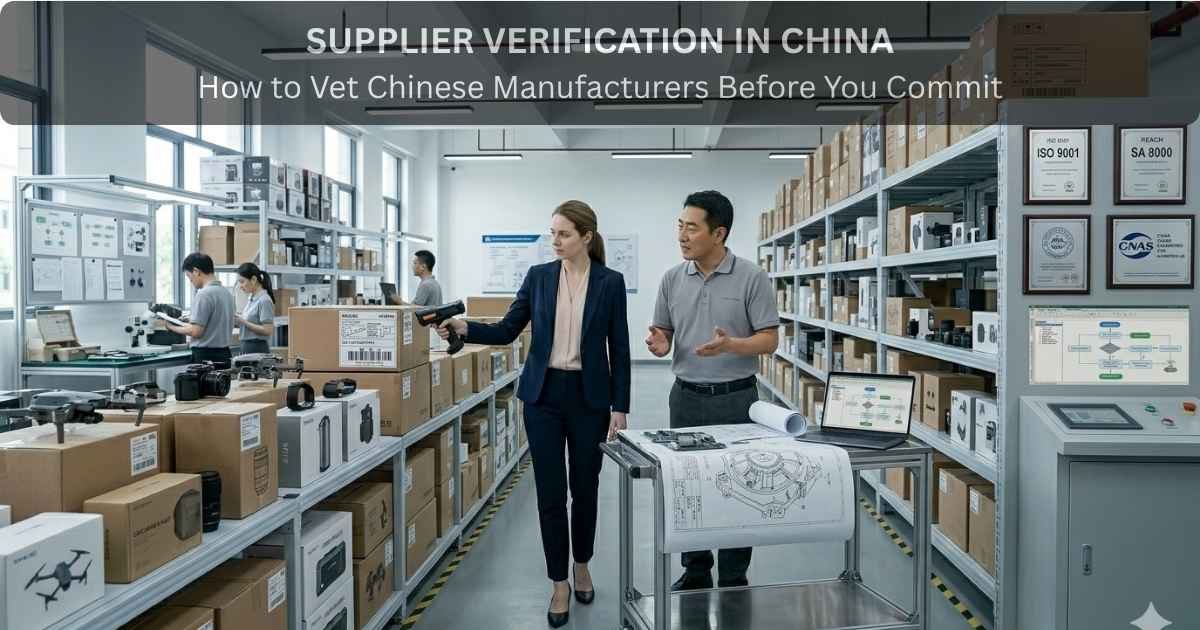
An audit is not a tour. A real factory audit confirms the company exists at its registered address, that the production lines for your product type physically exist and are running, that equipment and workforce match the capacity claimed, and that there is a quality-control function with documented procedures. It also looks at raw-material storage, work-in-progress and finished-goods handling — because that is where quality is won or lost.
You can see exactly what a structured audit catches in our aluminium pergola factory audit and wooden sauna factory audit case studies — both surfaced structural and process risks before scale-up.
GPS and live video verification
A flight to China for every supplier is not realistic, and it is no longer necessary. A live, GPS-stamped video walk-through gives you most of what an in-person visit gives you: you direct the camera, in real time, around the floor that is making your goods. The GPS stamp confirms the call is happening at the registered factory address and not in a rented showroom. Edited promotional factory videos prove nothing — anyone can commission one. A live call you control is the standard to insist on.
Quality systems and AQL
Verifying the factory is not the same as verifying the goods. That is the job of AQL inspection — Acceptable Quality Limit, the international sampling standard for deciding whether a production lot passes. A proper quality programme runs in three stages: pre-production (materials and tooling checked before the line starts), in-production (a mid-run inspection while problems are still cheap to fix), and pre-shipment (a final AQL sample drawn before the container is sealed). One inspection at the end only tells you it is too late.
An importer who only inspects pre-shipment finds defects when the only options left are reject the lot or ship it anyway. Inspect earlier and you have a third option: fix it.
Verify, then protect: the NNN agreement
Verification tells you a factory is real and capable. A contract decides what happens when something still goes wrong. The contract that works in China is an NNN agreement — Non-disclosure, Non-use, Non-circumvention — drafted in Chinese, under Chinese law, enforceable in a Chinese court.
The three N's matter individually. Non-disclosure stops your design and specs being shared. Non-use stops the factory making your product for itself or others. Non-circumvention stops them going around you to your customers. A Western-style NDA, translated or not, generally fails on all three because a Chinese court will not enforce it the way you assume. Sign the NNN before you share full specs and before any deposit moves.
Third-party, agent, or do it yourself
You have three routes. A third-party inspection firm is independent and good for one-off audits, though it does not manage the relationship afterwards. Doing it yourself is possible but means flights, language and knowing what you are looking at. A verified sourcing agent who lives in the manufacturing region combines verification with ongoing management — and is only as good as the vetting behind the word "agent".
Where Mila Sourcing fits
Mila Sourcing builds verification into the process so it is never the step you skip. Every importer is matched with one of 37 agents we have vetted ourselves, and Full Production Management runs licensed checks, GPS-verified audits, bilingual NNN contracts and 3-stage AQL quality control as standard. If you only need the front of that process, Sourcing Activation verifies the factory behind the quote before you commit.
Related reading: how to find reliable suppliers in China and supplier sourcing in China: a practical guide.