What a deposit is actually for
A deposit is working capital. The factory spends it the day your purchase order is confirmed, buying the steel, resin, fabric, or components your run needs. It will not float those materials out of its own pocket and wait 60 days to be paid. Once you see the deposit as the factory's material budget, the right number becomes a calculation rather than a feeling: enough to cover materials and the first run, without paying in full for goods that do not exist yet.
Is a 30% deposit normal in China?
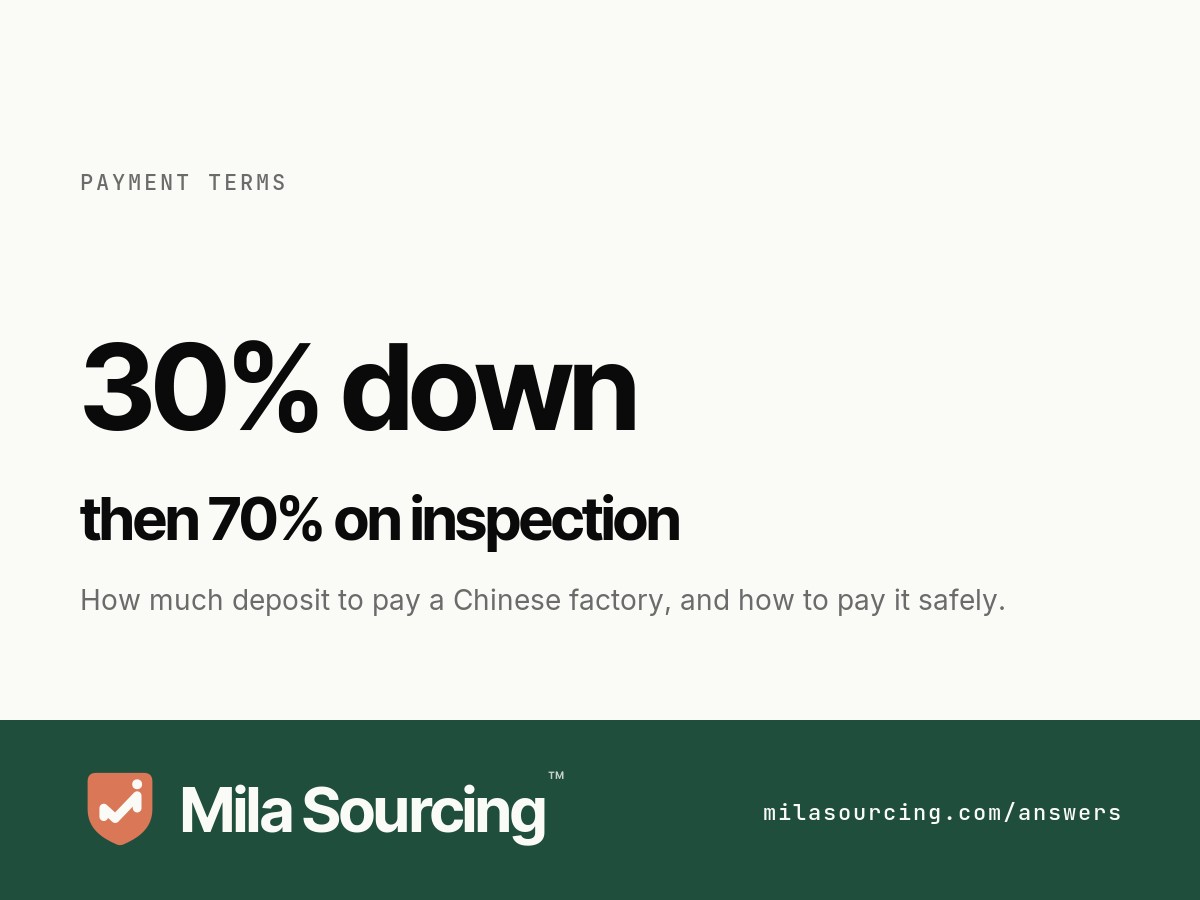
Yes. The default across almost every product category is 30% deposit and 70% balance, with the balance paid against a passed pre-shipment inspection. You'll see it written as "30/70 T/T", where T/T means telegraphic transfer, a plain bank wire. It is the global norm because it splits the risk evenly. The factory has enough to start. You hold the other 70% back until you, or an inspector acting for you, have seen what actually came off the line. On repeat orders with a factory you trust, terms loosen toward 20/80 or even open account. On a first order with a stranger, 30/70 is the line to hold.
When is a higher deposit actually fair?
Sometimes a bigger deposit is reasonable, and refusing it flat out marks you as someone who has never run a real order. Three cases earn the extra:
- Custom tooling and molds. An injection mold or a stamping die is worthless to anyone but you, so factories almost always ask for tooling to be paid in full up front, separate from the unit deposit. That's normal. Just make the mold yours in writing and get it photographed.
- Custom raw materials. A specific dyed fabric, a bespoke PCB, or a minimum material buy the factory cannot resell ties up money it cannot recover if you walk. Expect that covered.
- Very small orders. Below a factory's comfortable minimum (MOQ), 50% may be what makes the run worth scheduling at all.
Outside cases like those, a demand for 50% or 70% up front on a standard product is an opening offer you can push back on.
Can I negotiate a lower deposit?
Often, yes, and you get further by structuring the deal than by haggling on the headline number. Three moves that work:
- Tie payments to milestones. Offer 30% on order, 30% when production photos show your line actually running, and 40% after inspection. The factory still gets cash flow; you keep your checkpoints.
- Carve tooling out. Keep the mold payment on its own line so a scary "50%" ask shrinks the moment tooling is removed from the unit deposit.
- Route the first order through escrow. Alibaba Trade Assurance holds your payment until you confirm the order shipped to spec. For orders above roughly $50,000, an irrevocable letter of credit from your bank shifts the deposit risk onto the banks. Both cost a little and buy real protection.
Your order size decides the rest. A repeat buyer placing a six-figure order negotiates terms a first-timer ordering 500 units never will.
How do I pay the deposit safely?
Where the money goes matters more than how much it is. Most deposit fraud does not involve a fake factory at all. It happens on a real order, when the bank account you wire to has been swapped or the inbox you trust has been hijacked.
- Pay the registered company, never a person. The bank account name must match the legal company name on the business license (营业执照). A personal account, or a company name that doesn't match, is the single biggest red flag in China sourcing. Stop and verify before you send a cent.
- Confirm any account change by video, never by email. A supplier who emails "please use our new account" may be a hacker sitting on a compromised inbox. Business email compromise quietly drains real money from importers every week.
- Stick to traceable rails. A bank wire to the company account, Trade Assurance, or a letter of credit all leave a paper trail and some recourse. Western Union, crypto, or a friend's account leave none.
Deposit red flags
- A first-order demand for 100% payment up front on a standard product. Walk away.
- A deposit going to a personal account, or a company name that doesn't match the business license.
- Pressure to pay today to lock in a discount or hold a production slot.
- A brand-new bank account announced by email halfway through the order.
- A deposit percentage that quietly climbs every time you ask a hard question.
Where Mila Sourcing fits
Before you wire anything, we confirm the factory is real, the bank account matches the registered company, and the contract is a bilingual NNN that names the deposit and ties the 70% balance to a passed inspection, in writing. That balance is never released until our three-stage QC and pre-shipment inspection pass, and you watch every checkpoint inside one WhatsApp thread. That's the core of Sourcing Activation and Full Production Management.
Related, if you're setting terms with a supplier right now: